“But I don’t want comfort. I want God, I want poetry, I want real danger, I want freedom, I want goodness. I want sin.”“In fact,” said Mustapha Mond, “you’re claiming the right to be unhappy.”“All right then,” said the Savage defiantly, “I’m claiming the right to be unhappy.”“Not to mention the right to grow old and ugly and impotent; the right to have syphilis and cancer; the right to have too little to eat; the right to be lousy; the right to live in constant apprehension of what may happen tomorrow; the right to catch typhoid; the right to be tortured by unspeakable pains of every kind.” There was a long silence.“I claim them all,” said the Savage at last.
Monday, October 27, 2014
Brave New World


Saturday, October 18, 2014
Neuhaus - Hermeneutics of Suspicion
Neuhaus speaks of "the toxic cultural air of a disenchanted world in which the mark of sophistication is to reduce wonder to banality. Even more, the acids of intellectual urbanity turn sacrifice into delusion, generosity into greed, and love into self-aggrandizement. In academic circles, this is called 'the hermeneutics of suspicion,' meaning that things are interpreted to reveal that they are not in fact what they appear to be. At least things that seem to suggest the true, the beautiful and the good are not what they appear to be. They must be exposed and debunked if we are to get to 'the truth of the matter.' The false, the self-serving, the ugly and the evil, on the other hand, are permitted to stand as revealing 'the real world.'" (Chapter 4 of Death on a Friday Afternoon, p. 125)
Saturday, October 4, 2014
Santayana on William James
"Perhaps in the first years of his teaching he felt as a military man might feel when obliged to read the prayers at a funeral. He probably conceived what he said more deeply than a more scholastic mind might have conceived it; yet he would have been more comfortable if someone else had said it for him. I think he was glad when the bell rang, and he could be himself again until the next day. But in the midst of this routine of the class-room the spirit would sometimes come upon him, and leaning his head on his hand, he would let fall golden words, picturesque, fresh from the heart, full of the knowledge of good and evil." -- George Santayana on William James
Luna 3
October 4, 1959 -- the Soviet Luna 3 launches. Three days later, it would take the first ever images of the dark side of the moon. With no rockets to correct or aim the Luna's course, the means of getting this four foot tall hermetically sealed cylinder (read as: fancy garbage can) boomeranged into space, pointed in the right direction at the right moment to take a set of photos, develop the film, scan the film, and transmit them back to Earth was nothing short of a feat of technological acrobatics.

"Photograph 1" -- the first transmitted image. What a shame that all the original photos burned up with the ship.
The radiowave transmission of the photographs in the Luna 3 operated via a scanner which measured the intensity of light and dark pixels on the film. These areas (pixels) would be assigned an electronic value according to their intensity, encoding the image in a series of numbers which could then be transmitted back to earth via electromagnetic waves (radio waves) and reconstituted as an image--not unlike how a TV works. (Note to self: look up a better explanation of my cursory understanding of this.)
The Luna 3 spent the following five months locked in a looping ellipse, completing eleven orbits around the moon and Earth before falling back to Earth and disintegrating in the atmosphere in March, 1960.
A 2D image of 4D gymnastics.
(Rotated to approximate the photograph from the Luna 3).
The dark side of the moon (or, more accurately: the far side of the moon), as pictured by the Apollo 16 in 1972 -- Pink Floyd's Dark Side of the Moon came out shortly after, in March, 1973.
Sunday, April 6, 2014
Andrew Klein
Met an amazing artist on the bus home from a wedding in New Bedford today -- thought he was interesting from the moment I met him, but I had no idea how interesting. This is just a note to self for later.
https://www.facebook.com/media/set/?set=a.595711373798567.1073741831.188750624494646&type=3
http://andrewkleinpaintings.com/index.php?page=biography
https://www.facebook.com/media/set/?set=a.595711373798567.1073741831.188750624494646&type=3
http://andrewkleinpaintings.com/index.php?page=biography
Wednesday, March 26, 2014
Bon Appétit, Millie Brown!
Or, Millie Brown Vomits Art
Millie Brown is one strange, strange artist. She gulps down tall glasses of milk dyed with food coloring and then vomits all over a canvas she has placed on the floor. Then she gulps down another color of milk and does it again (and again) until she is satisfied the work is complete, all the while accompanied by two singers dressed as turtlenecked milk bottles singing Delibes' "Flower Duet." It should come as no surprise that the response to her work has been overwhelmingly negative for exactly this reason. Because she has Lady Gaga's support, many people are accusing both of them of glorifying bulimia. Many more people are saying her work is not art.
I think there is absolutely no question it is art.
I find it fitting that the YouTube video says "No description available."
Andy Warhol's Oxidation Paintings (better known as "Piss Paintings" -- take a guess how he made them) sell at Christie's for $1,900,000.

If only I could get paid for peeing on things. I'm just lucky if I don't get a ticket.
Piero Manzoni canned his own shit (a lot of it).

Each can sells for $50,000-$60,000 at auction. But then again, look at Manzoni's face: who could resist that shit-selling smile?

You'll be glad to know that it turns out it wasn't actually shit, he was just relabeling cans of pasta sauce. Again, a way better (read as: more practical) plan than vomiting on a canvas.
And let's not forget Cy Twombly's smeary pink and brown fecal efforts to mock Jackson Pollock's drip paintings.

Which brings us to Jackson Pollock himself: the first man to paint with his canvas on the floor of his studio; the first man to make a work of art simply by dribbling paint all over a canvas and allowing the alluvial action to produce an image; a man known for his "dance" around the canvas, expressing his inner Jungian subconscious for the benefit of mankind. Millie Brown has taken several pages from Jackson Pollock's book by painting with her canvas on the ground and allowing the paint to simply dribble (or heave, or gurgitate) onto the canvas. She takes Pollock's idea of expressing her inner self even further by imbibing her paint and upchucking it directly -- literally -- from inside her... her stomach. She claims she suffers from serious migraines, and I don't doubt she does; that's the inevitable result of literalizing Pollock's efforts to externalize one's interior genius.

Note also: Jackson Pollock did his works with style and glamor. He was a celebrity as much as any artist ever was. Having Lady Gaga on your team is nothing compared to Pollock. Since I've tabled the issue of bulimia, I'll also table the issue of alcoholism and Pollock's mental health.
And that's just getting to the 1950s.
In 1946, Marcel Duchamp ejaculated a painting (Paysage Fautif) and gave it to his girlfriend, Maria Martins.
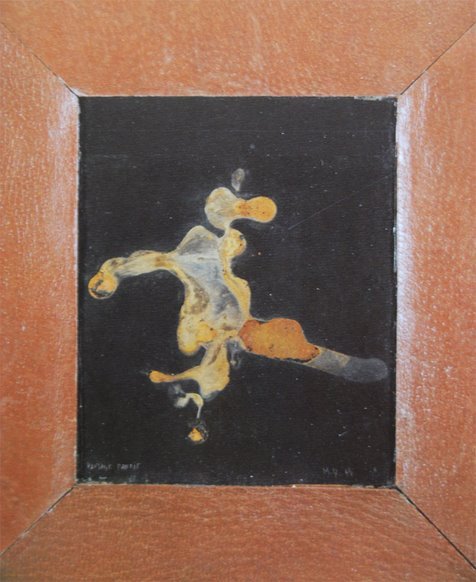
What a charmer!
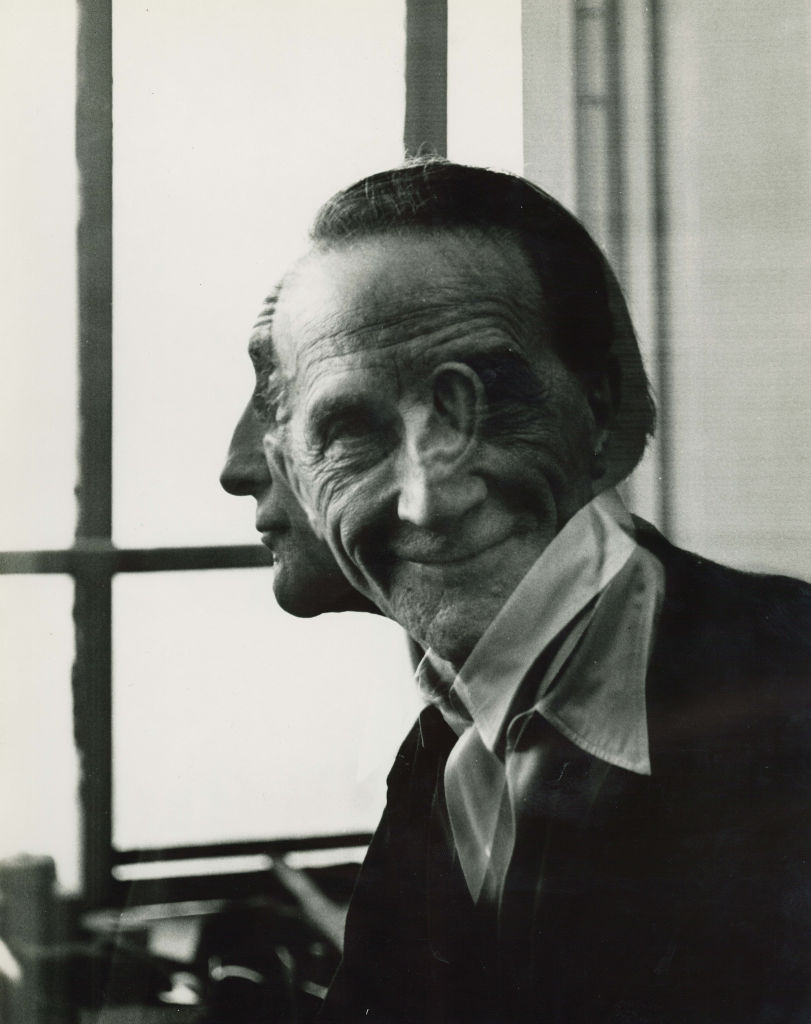
And Duchamp started his work decades before that. It took him years to get to ejaculating paintings. As everything in the twentieth century inevitably comes from Duchamp, so too can Millie Brown's vomitorium paintings can be traced back to Duchamp's watershed piece, The Fountain (1917).

In short, bravo Millie Brown! There's no question that what you are doing is art. The question is whether it's original, or any good, and whether or not the paycheck is worth the migraines.
Edit -- 11/1/2014 -- you'd think this sort of stuff would reach a level of one-upsmanship where no one would want to go, and yet, here we are again.
Friday, March 14, 2014
Edgar Lee Masters and Carroll Cloar

The best thing I've read this week is Edgar Lee Masters Spoon River Anthology. Coincidentally, the most interesting art I've happened across this week is Carroll Cloar, a southern surrealist.
Fiddler Jones
~~~
THE EARTH keeps some vibration going
There in your heart, and that is you.
And if the people find you can fiddle,
Why, fiddle you must, for all your life.
What do you see, a harvest of clover?
Or a meadow to walk through to the river?
The wind’s in the corn; you rub your hands
For beeves hereafter ready for market;
Or else you hear the rustle of skirts
Like the girls when dancing at Little Grove.
To Cooney Potter a pillar of dust
Or whirling leaves meant ruinous drouth;
They looked to me like Red-Head Sammy
Stepping it off, to “Toor-a-Loor.”
How could I till my forty acres
Not to speak of getting more,
With a medley of horns, bassoons and piccolos
Stirred in my brain by crows and robins
And the creak of a wind-mill—only these?
And I never started to plow in my life
That some one did not stop in the road
And take me away to a dance or picnic.
I ended up with forty acres;
I ended up with a broken fiddle—
And a broken laugh, and a thousand memories,
And not a single regret.
Edmund Pollard
~~~
I WOULD I had thrust my hands of flesh
Into the disk-flowers bee-infested,
Into the mirror-like core of fire
Of the light of life, the sun of delight.
For what are anthers worth or petals
Or halo-rays? Mockeries, shadows
Of the heart of the flower, the central flame!
All is yours, young passer-by;
Enter the banquet room with the thought;
Don’t sidle in as if you were doubtful
Whether you’re welcome—the feast is yours!
Nor take but a little, refusing more
With a bashful “Thank you,” when you’re hungry.
Is your soul alive? Then let it feed!
Leave no balconies where you can climb;
Nor milk-white bosoms where you can rest;
Nor golden heads with pillows to share;
Nor wine cups while the wine is sweet;
Nor ecstasies of body or soul,
You will die, no doubt, but die while living
In depths of azure, rapt and mated,
Kissing the queen-bee, Life!

Subscribe to:
Posts (Atom)