Monday, August 3, 2015

M110 - Andromeda's Children

M110 I found on accident when I was looking for M31 (Andromeda). Given the luck I was having at that point I was pretty glad to find anything at all.  It is apparently a satellite galaxy of Andromeda, a little elliptical galaxy just making its way around Andromeda as Andromeda slowly crashes into the Milky Way.  Messier originally thought it was part of M31, so it didn't get it's own catalog nmber until 1967.  There are fourteen other known dwarf galaxies (siblings, I suppose) that orbit Andromeda.  Next time I will shoot for the other visible dwarf galaxy, M32, and of course continue to try to find a way to get a decent shot of Andromeda.

M110
Magnitude +9.4.
Near Andromeda
August 1, 2015 01:00

(click to enlarge)

Wednesday, July 15, 2015

The Vanished Library - Luciano Canfora

Luciano Canforia (trans. Martin Ryle), The Vanished Library, (U of CA Press, 1987)

This is a book that really, sincerely wants a map in its efforts to trace the history of the Library of Alexandria.

Major takeaway: there is astoundingly little information about the Library of Alexandria.  Scholars even debate exactly where it was in Alexandria (attached to the main palace? or nearer to the coast?) who precisely started it (certainly Ptolemy II was King, but was it Aristotle or Demetrius who planted the idea), what was in it (See Callimachus below), how big it was (estimates range from 40k to 400k), or even what exactly the word bibliothekai meant ("library" or "book shelf"? the latter explains why it is so hard to find where the books were precisely given the expectation of the former[77]).

Thesis of Book: it is very unlikely Caesar's soldiers are responsible for the infamous burning of the Library. More likely, it was several separate fires and disasters over the course of a few centuries.

Points of Interest

  • Theophrastus, inheritor of the Aristotelean (Peripatetic) school, died and left his books to Neleus.  When Neleus was not elected as head of the school, he went home (Scepsis) and he took his ball with him (Aristotle's library) and explicitly thwarted the efforts of the Egyptian King (Ptolemy II) to make copies of Aristotle's library. Neleus is perhaps the most selfish man in history, and it is because of him Aristotle's library does not survive today.
  • Callimachus wrote a tremendous, 120 scroll treaty called the Catalogues. This book outlined his system for organizing the world's largest library.  Unfortunately it is completely lost.
  • The scholars who tended to the Library of Alexandria (Callimachus, Aristophanes, Demetrius) were not free to leave -- they were prisoners to the books, much like grad students.
  • There is a huge connection between Ptolemy's library and Judaism / preserving Jewish texts (23).  Ptolemy wanted a copy of everything written in the world -- every book that came to his city was copied -- this led to a significant increase in tolerance of Jews in Ancient Alexandria.  This was also the moment the Septuagint was miraculously translated.
  • The only library to rival Alexandria was the Library of Pergamum, which had a Harvard-Yale style rivalry with Alexandria that was mirrored in their different approaches to reading. Alexandrians were more interested in close reading, accurate translation, exposing forgeries, textual analysis, and setting into stone the meaning of words and works. At Pergamum, issues of textual doubt were mostly overlooked as anomalies -- they were more interested in "'hidden' meaning, the meaning that lay 'behind' the classical, and especially the Homeric, texts - the 'allegory.' as they called it, concealed in these poems." (49)
  • Parchment was invented in Pergamum because the Alexandrian's wouldn't sell them any papyrus for their scrolls.  The words are etymologically identical.


Favorite quotes:
1. Ptolemy made it a regular habit to ask advice of the Jewish scholars, whom he admired for their even-keeled responses always grounded on the logic of godliness.


2. Libraries were originally inspired by world domination, putting whole new meaning to the old adage "knowledge is power."

Macedonian arms had made the Greeks masters of the entire known world, from Sicily to North Africa, from teh Balkan peninsula to Asia Minor, and from Iran and India to Afghanistan, where Alexander had halted.  They did not learn the languages of their knew subjects, but they realized that if they were to rule them they must understand them, and that ot understand them they must collect their books and have them translated.  Royal libraries were accordingly created in all the Hellenistic capitals, not just for the sake of prestige but also as instruments of Greek rule. And the sacred books of the subjects had a special place in this systematic project of collection and translation, because religion was, for those who wished to rule them, a kind of gateway to their souls.

Friday, June 5, 2015

The Museum of 4 in the Morning

I was born at four in the morning.  4:10 to be exact, or so says the certificate.  That's exactly how I'd start my memoir if I ever had the nerve to write a memoir, or if I even thought that's where I began.  In any case, I feel a special kinship for the Museum of Four in the Morning (mofitm) for its fascinating chronocritical obsession.

By asking its audience to crowdsource any and all cultural references to that specific time, the mofitm has compiled a significant archive of 4 ams.  A remarkable thing happens as you scroll through more and more references (there are nearly 600 of them, if we count by number of Tweets): what seems to be merely a time of the day (or the morning), quotidian in the truest sense of the word, emerges from anonymity fully clothed in culturally constructed self-consciousness.

The phrase is less of a time and more of a hyperbolic expression of lateness.  4 a.m. isn't a time so much as it is an idea and a feeling.  It's a hyperbolic expression of lateness.  It's a bipolar hour, a space full of either mania or sleep.  It becomes more and more apparent that nothing actually happens precisely at 4 a.m., that the specificity of the time 4:00 is almost universally a white lie.  It means, simultaneously: "exceedingly late" and "exceedingly early." It seems insist upon the marriage of such opposites--it is simultaneously a time of extreme inactivity and extreme activity, particularly comprising the unpleasant mash of the two together.  Which of the two (late or early) it means in any given context or usage is hard to determine, it seems to mean both at the same time.  Such paradoxical duality in a temporal statement would be no surprise if we were talking about, say "noon" or "midnight," those moments that seems to stand between two days, between am and pm, that announce themselves as temporally peculiar therefore merit their own names and titles ("the witching hour")... but who would have thought that 4 am would find itself turned into an idiom, an expression, into a temporal idea of comparable liminality?

I was born at 4:10 a.m., March 16, 1988. Pisces.


Lesson learned: 1) the exploration of sets of ideas grouped under relatively random or frivolous categories can bring surprising insights; 2) crowdsourced databasing is fantastic -- leads to a "natural" or seemingly organic growth of archives that refuses the prejudices a singular curator would necessarily impose on it 3) Umberto Eco would love this.

Unsorted thoughts.

Who ever thought the Big Dipper looked like a giant spoon was the most unimaginative of stargazers.  If anything it looks like a giant question mark in the cosmos.  Recently I saw it rising in the northeast, hooking slowly over the horizon, looming evermore overheard, a slowly rising crescendo of cosmic uncertainty.  Or maybe it's an interrobang -- ‽

It recalls, to me, pseudomorphically Thomas Cole's Oxbow -- though his was asking a different question entirely.  I should look up different cultures and their imaginings of the ursa major -- http://en.wikipedia.org/wiki/Ursa_Major

--
Lately I've been feeling the anxious urge to read a dictionary.  I wonder if anyone else gets this feeling.  I know Robert DeMaria surely does -- surely one feels only more anxious once you finish reading it.  I wonder which one I'll shoot at next.
--

I should apply for Triple Canopy and attempt to enact my dedications book.  Youth fiction has to be full of excellent dedications. Sci Fi has to have a rich compendium of dedications.  What I am talking about here is a database of dedications.  None of the boring ones -- the boring ones ("to my mom" "to my adoring husband" "thanks for putting up with me") can be cataloged as a statistic: i.e., 95% of all dedications are total boring drivel, saccharine redundancy befitting the speeches professional athletes give after winning a championship. Who cares about a precise statistic anyway? Let's just say it: 99% of dedications are totally boring. But then again... so are 99% of most things written! The collection of dedications I have so far are in completely different genres.. there needs to be a good categorization.

What is the point of the dedication exactly: the theory of dedicating.  OED: "3.a. To inscribe or address (a book, engraving, piece of music, etc.) to a patron or friend, as a compliment, mark of honour, regard,"

It is a moment of humility (turned funny / ironic by the lack of it often) written, ideally, at the end of such a project, at which someone acknowledges a single figure or source without which the book wouldn't have been possible.  It's the acknowledgement (but it is not the acknowledgements: I regard that as an entirely separate genre of writing) that everything ever written or made is built on the creation of something previous; the ol' Sagan adage: "to make an apple pie from scratch one must create the universe" -- in this way one could see the research and focus on dedications as one way of tracing influence.

The American literature category seems to be a good one.  It could actually be a useful resource to have such a database available.

American children's literature could be a sub category of that.  This is really a matter of going through the shelves.  19th century books have probably already been scanned and the work can be done online.  20th century might require a lot of just flipping through teh shelves and photographing.


[return to this..]

----


I need to get better at teamwork, that is, sharing ideas and working together with others to enact them.  Otherwise they all just die in my head.
Color pianos. Playing images.

Monday, April 6, 2015

Grandma June

June Arlene Yarborough

One of the most important things my grandmother ever taught me is that there is always more toothpaste in the tube.

Always.

Phenomenologically speaking, the toothpaste tube is a bag of holding, Felix the Cat's magic bag, an infinite space that can always collapse further with sufficient kneading (needing).

Thursday, March 5, 2015

Barry Lopez - Arctic Visions

1. Order of the Universe
Barry Lopez's fine ecocriticism ("green" writing, if you will) was a pleasure to read.  I've read him in other contexts -- he is a superb writer, a modern St. Francis.  Chapter 5, "Migration," Lopez's extended meditation on the migrations of humans, birds, whales, life, and time across the Bering Strait immediately calls to mind Chapter 87 of Moby-Dick, "The Grand Armada" where Ishmael engages in a similar sort of meditation as the Pequod nears the straits of Sunda. My favorite line from that chapter (as Ishmael is surrounded by an enormous pod of whales):

And thus, though surrounded by circle upon circle of consternations and affrights, did these inscrutable creatures at the centre freely and fearlessly indulge in all peaceful concernments; yea, serenely revelled in dalliance and delight. But even so, amid the tornadoed Atlantic of my being, do I myself still for ever centrally disport in mute calm; and while ponderous planets of unwaning woe revolve round me, deep down and deep inland there I still bathe me in eternal mildness of joy.

Lopez says much that is worth comparing.

Watching the animals come and go, and feeling the land swell up to meet them and then feeling it grow still at their departure, I came to think of the migrations as breath, as the land breathing.  In spring a great inhalation of light and animals. The long-bated breath of summer. And an exhalation that propelled them all south in the fall. (p.162) 

Both Ishmael and Lopez come to feel themselves made tiny, suddenly sucked into something so much greater than themselves. For Ishmael, he is surrounded by a deistic calmly whirling clock of sperm whales -- Lopez experiences something more mystic and deist, but fundamentally wedded to an understanding that the landscape is part of something much greater than anything contained within human reason.

2. Limits of Taxonomy
This is, perhaps, the most important quote to take from Lopez in relation to this exhibition.
We delineate the life history of the ground squirrel. We list the butterflies: the sulphurs, the arctics, a copper, a blue, the lesser fritillaries. At a snap [CAMERA]. We enumerate the plants. We name everything. Then we fold the charts and the catalogs, as if, except for a stray fact or two, we were done with a competent description.  But the land is not a painting; the image cannot be completed this way.

Here Lopez quashes the uniquely human attempt to understand the universe by means of quantification, replication, documentation, etc. Fundamentally: you cannot photograph this: it is already gone. The limits of catalog quantification -- I think of Melville trying to quantify the Galapagos Islands in The Encantadas only to show, by the attempt to do so, the failure of science, of taxonomy, of mere numbers, to really understand anything about the islands themselves.  In doing this, Melville responds and mocks the efforts of Charles Darwin's scientific catalogs of birds around the Galapagos -- Melville wasn't on board with the theory of evolution immediately.  We see a similar sort of mockery of the limits of scientific quantification in "Cetology" -- but this point is made constantly through the course of Moby-Dick, in which chapter after chapter attempts to explain what the heck whales are through the lens of just about every theory, methodology, discipline possible only to ultimately come up short.  We can see Lopezand Melville poking holes in the attempts of the explorer, the scientist, the prospector, to understand the landscape. "No!" they tell us, "you need a poet."

3. TIME
Lopez:
 ...Time pools in stillness here and then dissipates. The country is emptied of movement. George De Long called it "a glorious country to learn patience in." Time here like light, is a passing animal. Time hovers above the trundra like the rough-legged hawk, or collapses altogether like a brid keeled over with a heart attack, leaving the stillness we call death.....But even here time is on the verge of collapse....the Arctic is a long, unbroken bow of time....it is possible to feel the slope of time, how very far from Mesopotamia we have come. (p. 171-2)

Lopez makes an important point, one that is closely wedded with the environmental/global warming aspect of this exhibition: we must respect the nonhuman conception of time. The geological conception of time. Time as fundamentally not operating on any human scale, but a time completely separate from humans and humanity. In this sense, the Arctic is a vast symbolization of the fact that the world existed without us, existed before us, will continue after us (as the white whale swims on), and is not subject to us. Lopez (and Ishmael) see in the whale and in the Arctic a separateness from us, and a oneness with something greater -- both whale and the Arctic topple Humanity off its 19th century, puritan pedestal as master of the world, top of the food chain, king of the hill.  Lopez sees in the Arctic that our ancestors (Dorset, Thule, Eskimo) too were a part of the very same migratory chain that carries whales birds caribou and porpoises north and south again every year.

4. Lopez as Ishmael 
At the end of the chapter, we see Lopez transform fully into Ishmael as he asks himself: 
"In moments when I felt perplexed that I was dealing with an order outside my own, I discovered and put to us a part of my own culture's wisdom, the formal divisions of Western philosophy--metaphysics, epistemology, ethics, aesthetics, and logic--which pose, in order, the following questions. What is real? what can we understand? How should we behave? What is beautiful? What are the patterns we can rely upon?  As I traveled I would say to myself, What do my companions see where i see death? Is the sunlight beautiful to them, the way it sparkles on the water? Which for the Eskimo hunter are the patterns to be trusted? The patterns, I know, could be different from ones I imagined were before us." (202-203)

If we can agree that Barry Lopez is a "Green Writer," then we can certainly agree that Ishmael is too. The two are concerned not just with describing the outward appearances of the landscape around them, but also constantly coming to higher, metaphysical understandings of the universe and their place within it through their extended meditations. For both of them, the landscape becomes an inexhaustible fuel for the engine of their metaphors. The Arctic is a poetic landscape.

5. Ethnography
In Lopez descriptions of tools and ethnographic artifacts, I was overwhelmed by a divergence in Arctic and Western thought -- these tools, objects, carefully crafted with utilitarian purpose.  "A student working a Thule site on Ellesmere Island told me about a harpoon head she had found. 'All they had to do with it was catch a walrus. But they made it beautiful.' she said.  The admiration one feels kneeling over the pathetic remains of an early ASTt campsite can be very deep. What tenacity. What courage.  Another sort of feeling comes over one at a Thule site. One misses any sense of remoteness or separation and feels instead profound respect. A  powerful, dignified people, one imagines. The delicate and robust tools, as the student said, are beautiful." -- for Westerners, God is in the details. Beauty is in the details. Like Michelangelo's Sistine Chapel ceiling, painted in such fine detail as no one below would have been able to see, God existed for Michelangelo in the details.  But here, in these artefacs, we see the same concern for detail on a completely different scale.  It is no longer God in the details, it is survival. Survival is in the details. In understanding the different freezing points of different types of caribou fat. In the careful craftsmanship of the harpoon head described by the student. And the museum-goer will be overwhelmed (I hope) just like the student, by that beauty in the details. The beauty of survival. This is am important point to convey in your exhibition when presenting the ethnographic artifacts.

Friday, February 27, 2015

Eco on Lists

Umberto Eco's book on lists is one of those books you wish you had written yourself. In honor of his genius work on a topic I know so very well, here is the beginning of a list I wish I had started long ago:

Favorite words --

glib

scumble

abecedarian

deipnosophist

twee


I used to keep so many lists of good words and I fell out of the habit sometime (somehow!) in graduate school.  Back to this.  Add it to my New Years Resolutions.

Sunday, February 22, 2015

New Years Resolutions 2015

These came late, but I have some goals here:


1. Long term goal: Become a member of the Newbery Medal committee and Caldecott committee so I can officially read and judge children's books.  How does that even work?  How fantastic would that be?--to meet the people at these conferences, to have direct insight into the world of children's lit?  I wonder if I could get Steven Brown into this idea.

2. Exercise more. 5x/week.  So far so good.

3. Become a Resident Tutor so I can better participate as a friend and mentor in this fantastic community of young geniuses noodling about in Cambridge.  Re-orient all your random art projects to include the skills and interests of your students.  Collaborate.

4. Figure out what the hell I'm going to do with my stocks.  Keep my eye on that.

5. Travel someplace interesting this summer.  I think I need to walk a great distance. "Yet everyone on earth feels a tickling at the heels; the small chimpanzee and the great Achilles alike."

6.  Finish your dissertation prospectus. This is actually goal number 1.

7.  Re-write your old papers and publish them in non-academic places.  This is a silly goal but I want to do something with them.  No one really wants to read academic journals and only two of these papers are worth the effort.  Publish your stuff all over the place where people actually like to read and you can have more fun of it without all the academic futzing.  Orient your research so you can justify traveling to neat collections in the process.

8. Try and win that darn Bowdoin Prize. Quit telling people about it because Steven Brown will kick your butt at this thing.

9. Drink more water.  Lots more.

10. Get higher than a 4.5 on your Q scores.

11. Gracefully turn 27.

12. Structure your movie-watching more productively.  Something old, something popular, something artsy.  Brattle Theater should help you here.

13. MUCH more effort to eat my meals with people. Spend more time tasting your food and paying attention to all the interesting people you're surrounded by.

14. Sunday should be a day for learning to cook something new, and making it in amounts that it covers your lunch for a couple days.

15. More lists, thanks to Umberto Eco.

16. Once you get your camera, start hunting Messier objects.

hmm I suppose I should think about long term goals...

=Learn Italian and Spanish conversationally.
=Work on your Melville & Renaissance research with an i Tatti fellowship.
=Work with Rachel Sussman on her chrono-art.
=Find a way to make it to the AZ telescope, Mauna Kea, and Chile.
=Study under a Hilla Rebay fellowship.


Summer Reading Lists:
Read through the Newbery books.
Read through the Hugo Award books.
Read through your compiled Education books, and begin working on that philosophy.
Lists: Umberto Eco has given words to something you've always loved.  The organizing aggregative force of lists...

Wednesday, February 4, 2015

In memoriam Walter Liedtke

My favorite memory of Walter Liedtke was when he was giving our intern group a tour of the Dutch and Flemish Galleries of the Met, and, gesticulating vigorously, he unintentionally, unmistakably, loudly, rapped the surface of one of the Met's Vermeers with his knuckle.

The whole gallery went absolutely silent.

And he just went on... "When you're a curator, you can do that sort of thing!" 

What a tremendous loss.
 

Tuesday, November 25, 2014

Norman Mailer's Lego Utopia

Today I learned that Norman Mailer built a 7-foot tall Lego utopia which he keeps in his apartment in Brooklyn Heights.


"Thirty-three years later, however, the city still stands in Mailer’s living room in Brooklyn Heights, and its creator remains enthusiastic about his project. “It was very much opposed to Le Corbusier. I kept thinking of Mont-Saint-Michel,” he explains. “Each Lego brick represents an apartment. There’d be something like twelve thousand apartments. The philosophers would live at the top. The call girls would live in the white bricks, and the corporate executives would live in the black.” The cloud-level towers, apparently, would be linked by looping wires. “Once it was cabled up, those who were adventurous could slide down. It would be great fun to start the day off. Put Starbucks out of business.”


I wonder where it is now that he has passed away?

Thursday, November 6, 2014

Louis Adamic on BMC

All quotes from Harper's Monthly Magazine, "Education on a Mountain"

"They [the students] swim in intellgience and the desire to improve themselves.  Then uncertainty steals upon them, and they sink again into depression.  Not that the process ends here. They are continuous waves" (524)

"Men suffer most from unacknowledged self-contempt... He tries to act in such a way that he will be respected by others, and he becomes confused into thinking finally that this assumed self-respect he has pawned off on others is a reality. But underneath he knows or feels that it is all a lie.  Behind the front he offers to the world he is a disorderly person.  He never knows when he walks into a room but that the enemy is waiting for him, ready to show him up for the liar he is.  And yet, unconsciously, he longs for this very thing to happen to him.  But at the first onslaught of the real enemy he will fight as if he were a real enemy instead of a friend.  He has constructed and elaborately decorated the superficial self that he is to present to society.  It is as if he wore a carefully designed [pasteboard] mask, to the making of which he ha s given the most tender care, and behind this lives the real man, growing increasingly chaotic, miserable, and unhappy, longing for his deliverer but ready to receive him as an enemy.  The task of the college is to be his enemy-friend [frenemy]: the bitter enemy of the superficial self, the friend of the real self.   But the real one is starved, emaciated.  It must be fed back to life, while the superficial one must be attacked without mercy." [524]


"[John Andrew Rice says] A good teacher is always more a learner than teacher, making the demand of everyone to be taught something....A man who never asks himself any questions had better not try asking others....A teacher must have something of humor, a deeply laid irony, and not be a cynic.  In the center of his being should be a calm, quiet, tough. ["But even so, amid the tornadoed Atlantic of my being, do I myself still for ever centrally disport in mute calm; and while ponderous planets of unwaning woe revolve round me, deep down and deep inland there I still bathe me in eternal mildness of joy."] He must have in him the principle of growth; like the student, a sense of justice and a great capacity for dejection.
Teachers in a place like this, where education is taken seriously, should always bear in mind that they are the central problem; that we would provide the students with a liberal education if we merely gave them the privilege of looking on while we educated ourselves.  Also, that it's wrong for us to want others to be like ourselves; that we must want to attend to being the sort of people that others ought to be like." (526)

Poems as Constellations


Approach to the poem must be from afar off, even generations off. A reader should close in on it on converging lines from many directions like the divisions of an army upon a battlefield. A poem is best read in the light of all the other poems ever written. We read A the better to read B (we have to start somewhere; we may get very little out of A) .We read B the better to read C, C the better to read D, D the better to go back and get something more out of A. Progress is not the aim, but circulation. The thing is to get among the poems where they hold each other apart in their places as the stars do.

Robert Frost, "The Prerequisites," Selected Prose of Robert Frost, ed. Hyde Cox and Edward Connery Lathem (New York: Holt, Rinehart & Winston, 1966) , p. 97.


[W]hat happens when a new work of art is created is something that happens simultaneously to all the works of art which preceded it. ...The existing order is complete before the new work arrives; for order to persist after the supervention of novelty, the whole existing order must be, if ever so slightly, altered; and so the relations, proportions, values of each work of art toward the whole are readjusted; and this is conformity between the old and the new. Whoever has approved this idea of order, of the form of European, of English literature will not find it preposterous that the past should be altered by the present as much as the present is directed by the past.

T. S. Eliot, "Tradition and the Individual Talent," Selected Prose, ed. John Hayward (Harmondsworth: Penguin, 1953), p. 23.

Wednesday, November 5, 2014

Whow‽

I invented a new word today when I had a pen stutter while annotating:

"Whow"

"Whow" expresses both the exclamation of surprise (wow!) and the question implied ("but how was it done?") -- best coupled with the new hybrid punctuation "?!", the so called "interrobang":‽


Another neologism tonight: "connecticanadian" (noun or adjective), must be said aloud for full effect "con-ECT-uh-kuh-NAY-dee-an" -- refers to a Canadian transplant to CT; very friendly, garrulous type, says "sohwry" a lot, usually Caucasian.

Monday, October 27, 2014

Brave New World

“But I don’t want comfort. I want God, I want poetry, I want real danger, I want freedom, I want goodness. I want sin.”
“In fact,” said Mustapha Mond, “you’re claiming the right to be unhappy.”
“All right then,” said the Savage defiantly, “I’m claiming the right to be unhappy.”
“Not to mention the right to grow old and ugly and impotent; the right to have syphilis and cancer; the right to have too little to eat; the right to be lousy; the right to live in constant apprehension of what may happen tomorrow; the right to catch typhoid; the right to be tortured by unspeakable pains of every kind.” There was a long silence.
“I claim them all,” said the Savage at last.

Saturday, October 18, 2014

Neuhaus - Hermeneutics of Suspicion

Neuhaus speaks of "the toxic cultural air of a disenchanted world in which the mark of sophistication is to reduce wonder to banality. Even more, the acids of intellectual urbanity turn sacrifice into delusion, generosity into greed, and love into self-aggrandizement. In academic circles, this is called 'the hermeneutics of suspicion,' meaning that things are interpreted to reveal that they are not in fact what they appear to be. At least things that seem to suggest the true, the beautiful and the good are not what they appear to be. They must be exposed and debunked if we are to get to 'the truth of the matter.' The false, the self-serving, the ugly and the evil, on the other hand, are permitted to stand as revealing 'the real world.'" (Chapter 4 of Death on a Friday Afternoon, p. 125)    

Saturday, October 4, 2014

Santayana on William James

"Perhaps in the first years of his teaching he felt as a military man might feel when obliged to read the prayers at a funeral.  He probably conceived what he said more deeply than a more scholastic mind might have conceived it; yet he would have been more comfortable if someone else had said it for him.  I think he was glad when the bell rang, and he could be himself again until the next day.  But in the midst of this routine of the class-room the spirit would sometimes come upon him, and leaning his head on his hand, he would let fall golden words, picturesque, fresh from the heart, full of the knowledge of good and evil." -- George Santayana on William James

Luna 3

October 4, 1959 -- the Soviet Luna 3 launches.  Three days later, it would take the first ever images of the dark side of the moon.  With no rockets to correct or aim the Luna's course, the means of getting this four foot tall hermetically sealed cylinder (read as: fancy garbage can) boomeranged into space, pointed in the right direction at the right moment to take a set of photos, develop the film, scan the film, and transmit them back to Earth was nothing short of a feat of technological acrobatics.


"Photograph 1" -- the first transmitted image. What a shame that all the original photos burned up with the ship.

The radiowave transmission of the photographs in the Luna 3 operated via a scanner which measured the intensity of light and dark pixels on the film.  These areas (pixels) would be assigned an electronic value according to their intensity, encoding the image in a series of numbers which could then be transmitted back to earth via electromagnetic waves (radio waves) and reconstituted as an image--not unlike how a TV works.  (Note to self: look up a better explanation of my cursory understanding of this.)

The Luna 3 spent the following five months locked in a looping ellipse, completing eleven orbits around the moon and Earth before falling back to Earth and disintegrating in the atmosphere in March, 1960.


A 2D image of 4D gymnastics.


(Rotated to approximate the photograph from the Luna 3).

The dark side of the moon (or, more accurately: the far side of the moon), as pictured by the Apollo 16 in 1972 -- Pink Floyd's Dark Side of the Moon came out shortly after, in March, 1973.

Sunday, April 6, 2014

Andrew Klein

Met an amazing artist on the bus home from a wedding in New Bedford today -- thought he was interesting from the moment I met him, but I had no idea how interesting.  This is just a note to self for later.

https://www.facebook.com/media/set/?set=a.595711373798567.1073741831.188750624494646&type=3

http://andrewkleinpaintings.com/index.php?page=biography

Wednesday, March 26, 2014

Bon Appétit, Millie Brown!

Or, Millie Brown Vomits Art

Millie Brown is one strange, strange artist.  She gulps down tall glasses of milk dyed with food coloring and then vomits all over a canvas she has placed on the floor.  Then she gulps down another color of milk and does it again (and again) until she is satisfied the work is complete, all the while accompanied by two singers dressed as turtlenecked milk bottles singing Delibes' "Flower Duet."  It should come as no surprise that the response to her work has been overwhelmingly negative for exactly this reason.  Because she has Lady Gaga's support, many people are accusing both of them of glorifying bulimia.  Many more people are saying her work is not art.

I think there is absolutely no question it is art.

I find it fitting that the YouTube video says "No description available."

Here is why I think it is art.  Millie Brown's work has a tremendous line of art historical precedent -- art made with far grosser effluvia that was easier to create and sells for more money.  Heck, she is only making $20,000 a canvas and look at all the work she has to do!

Andy Warhol's Oxidation Paintings (better known as "Piss Paintings" -- take a guess how he made them) sell at Christie's for $1,900,000.


If only I could get paid for peeing on things.  I'm just lucky if I don't get a ticket.

Piero Manzoni canned his own shit (a lot of it).


Each can sells for $50,000-$60,000 at auction.  But then again, look at Manzoni's face: who could resist that shit-selling smile?

You'll be glad to know that it turns out it wasn't actually shit, he was just relabeling cans of pasta sauce.  Again, a way better (read as: more practical) plan than vomiting on a canvas.

And let's not forget Cy Twombly's smeary pink and brown fecal efforts to mock Jackson Pollock's drip paintings.


Which brings us to Jackson Pollock himself: the first man to paint with his canvas on the floor of his studio; the first man to make a work of art simply by dribbling paint all over a canvas and allowing the alluvial action to produce an image; a man known for his "dance" around the canvas, expressing his inner Jungian subconscious for the benefit of mankind.  Millie Brown has taken several pages from Jackson Pollock's book by painting with her canvas on the ground and allowing the paint to simply dribble (or heave, or gurgitate) onto the canvas.  She takes Pollock's idea of expressing her inner self even further by imbibing her paint and upchucking it directly -- literally -- from inside her... her stomach.  She claims she suffers from serious migraines, and I don't doubt she does; that's the inevitable result of literalizing Pollock's efforts to externalize one's interior genius.


Note also: Jackson Pollock did his works with style and glamor.  He was a celebrity as much as any artist ever was.  Having Lady Gaga on your team is nothing compared to Pollock.  Since I've tabled the issue of bulimia, I'll also table the issue of alcoholism and Pollock's mental health.

And that's just getting to the 1950s.

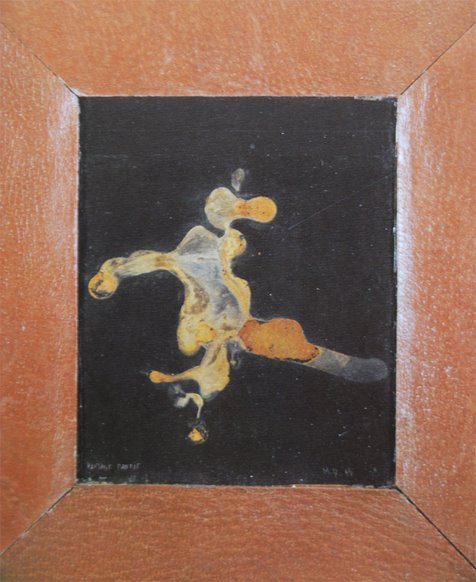
In 1946, Marcel Duchamp ejaculated a painting (Paysage Fautif) and gave it to his girlfriend, Maria Martins.


 What a charmer!


And Duchamp started his work decades before that.  It took him years to get to ejaculating paintings.  As everything in the twentieth century inevitably comes from Duchamp, so too can Millie Brown's vomitorium paintings can be traced back to Duchamp's watershed piece, The Fountain (1917).


In short, bravo Millie Brown!  There's no question that what you are doing is art.  The question is whether it's original, or any good, and whether or not the paycheck is worth the migraines.


Edit -- 11/1/2014 -- you'd think this sort of stuff would reach a level of one-upsmanship where no one would want to go, and yet, here we are again.

Friday, March 14, 2014

Edgar Lee Masters and Carroll Cloar


The best thing I've read this week is Edgar Lee Masters Spoon River Anthology.  Coincidentally, the most interesting art I've happened across this week is Carroll Cloar, a southern surrealist. 

Fiddler Jones
~~~
THE EARTH keeps some vibration going   
There in your heart, and that is you.   
And if the people find you can fiddle,   
Why, fiddle you must, for all your life.   
What do you see, a harvest of clover?            
Or a meadow to walk through to the river?   
The wind’s in the corn; you rub your hands   
For beeves hereafter ready for market;   
Or else you hear the rustle of skirts   
Like the girls when dancing at Little Grove.     
To Cooney Potter a pillar of dust   
Or whirling leaves meant ruinous drouth;   
They looked to me like Red-Head Sammy   
Stepping it off, to “Toor-a-Loor.”   
How could I till my forty acres     
Not to speak of getting more,   
With a medley of horns, bassoons and piccolos   
Stirred in my brain by crows and robins   
And the creak of a wind-mill—only these?   
And I never started to plow in my life     
That some one did not stop in the road   
And take me away to a dance or picnic.   
I ended up with forty acres;   
I ended up with a broken fiddle—   
And a broken laugh, and a thousand memories,     
And not a single regret.   


Edmund Pollard
~~~
I WOULD I had thrust my hands of flesh   
Into the disk-flowers bee-infested,   
Into the mirror-like core of fire   
Of the light of life, the sun of delight.   
For what are anthers worth or petals            
Or halo-rays? Mockeries, shadows   
Of the heart of the flower, the central flame!   
All is yours, young passer-by;   
Enter the banquet room with the thought;   
Don’t sidle in as if you were doubtful     
Whether you’re welcome—the feast is yours!   
Nor take but a little, refusing more   
With a bashful “Thank you,” when you’re hungry.   
Is your soul alive? Then let it feed!   
Leave no balconies where you can climb;     
Nor milk-white bosoms where you can rest;   
Nor golden heads with pillows to share;   
Nor wine cups while the wine is sweet;   
Nor ecstasies of body or soul,   
You will die, no doubt, but die while living     
In depths of azure, rapt and mated,   
Kissing the queen-bee, Life!